Fitness Program Beginners: What Week One Should Look Like
Most people quit in the first ten days. Not because they are lazy, and not because they picked the wrong exercises. They quit because week one felt like punishment. A good fitness program for beginners is supposed to feel almost too easy at the start, which is the part nobody tells you. Your first week is not about burning the most calories or hitting a personal record. It is about showing up, learning how the movements feel, and proving to yourself that this fits into the life you already have. Here is what that week actually looks like when it is built properly.
Start with three days, not six
The instinct is to go all in. Six days a week, two hours a session, cardio on top. That schedule works for about nine days and then life gets in the way, you miss two sessions, and the whole thing feels broken.
Three training days is the sweet spot for week one. Monday, Wednesday, Friday, or whatever three days you can protect. Each session runs 45 to 60 minutes. That is enough to give your body a real stimulus and enough recovery time between sessions that you are not walking around sore and miserable.
Three days also builds something more useful than muscle in that first week: a habit you can repeat. If you can hit three sessions for four weeks straight, adding a fourth day later is easy. If you start at six and drop to two, you have taught yourself that the plan does not work. It does. The schedule was just wrong.
When you are mapping out your week, be honest about your calendar before you commit. The people who get results with structured coaching are almost always the ones who built the schedule around their real life instead of an ideal version of it.
What your first session should actually include
Full body. Every session, all three days. Beginners do not need a chest day and a back day yet, because you get more out of hitting each muscle group three times a week with lighter loads than once a week with heavy ones.
A clean week one session looks something like this:
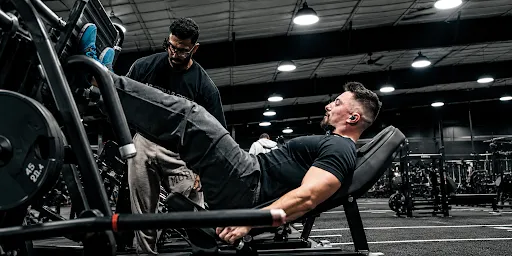
A squat pattern (goblet squat or leg press)
A hinge pattern (dumbbell Romanian deadlift or hip thrust)
A push (dumbbell bench press or push-up)
A pull (lat pulldown or seated row)
A core movement (dead bug or plank)
Two to three sets each, 8 to 12 reps, stopping about three reps before you physically cannot do another. That last part matters. In week one you are not training to failure, you are training to learn. Leaving reps in the tank means you finish the session able to think clearly, and you show up on Wednesday instead of nursing something.
If the former side of things feels intimidating, that is normal, and it is exactly why hands-on session work exists. Getting corrected in real time during your first two weeks saves you months of grinding a bad pattern into your body.
Do not touch cardio yet
This one surprises people. You do not need to add cardio in week one.
Your body is already handling a brand new stressor. Resistance training on its own is going to make you sore, hungry, and tired in ways you are not used to. Piling 40 minutes of treadmill work on top of that just makes the whole week harder to survive without meaningfully speeding up fat loss.
If you want movement on your off days, walk. Aim for a step count you can hit without scheduling anything, something like 7,000 to 9,000 steps a day. Walking recovers you instead of digging the hole deeper, it burns real calories over a week, and it is nearly impossible to fail at.
Structured cardio can come in around week four or five, once your training sessions feel routine and your recovery has caught up. There is no prize for adding everything at once. If you are not sure how conditioning should fit alongside lifting for your goal, the breakdown of available session formats is a useful starting reference.
Eat enough to actually train
The most common week one mistake is starting a new training program and a 1,200 calorie diet on the same Monday. You will feel terrible, your sessions will suffer, and you will associate training with misery.
Week one, do two things with food. First, get protein. Roughly 0.7 to 1 gram per pound of your goal bodyweight, spread across your meals. Protein keeps you full, protects muscle while you lose fat, and helps you recover between sessions. Second, track what you are actually eating without changing much else. Most people are genuinely shocked by what a week of honest logging shows them.
That is it. No cutting out food groups, no clean eating rules, no eliminating the things you enjoy. This is the approach Krishna Mansukhani built Antman Fitness around, and the reason it works is simple: a plan you resent is a plan you abandon. Flexible eating keeps the plan survivable long enough for the results to show up.
Once your baseline is clear, then you set a calorie target. Not before.
Expect week one to feel weird
Here is what is normal in your first seven days, so none of it scares you off.
You will be sore. Delayed onset muscle soreness peaks around 24 to 48 hours after a session, and it is worse after the very first one. It fades fast as your body adapts. Keep moving through it. Walking and light activity help more than lying on the couch.
Your weight might go up. New training causes water retention in the muscles you just worked. Seeing the scale climb two pounds in week one is not fat gain, it is inflammation and glycogen. Ignore it.
You will feel hungrier. Also normal, and another reason not to slash calories in week one.
Your energy will dip mid-week and then come back. Sleep is the lever here. Seven to eight hours does more for your first month of progress than any supplement you can buy.
None of this means the program is wrong. It means your body is responding to something new. Scroll through real clients before and after results and you will notice the pattern: almost nobody has a dramatic week one. The change shows up in months two, three and four, built on weeks that were unremarkable.
Track the things that predict success
Weight is a noisy number, especially in the first month. Track it if you want, but do not let it grade your week.
Better week one metrics:
Did you hit all three sessions?
Did you log your food most days?
Did you sleep seven hours or more, most nights?
Did you hit your step target?
Did the weights feel a little easier by session three?
Those five answers predict where you will be in six months far better than the scale does. A beginner workout plan works because of consistency, and consistency is measurable long before the mirror changes.
Write your numbers down. Weights used, reps completed, how the session felt. Week four gets a lot more motivating when you can look back at week one and see the jump. If you want an outside set of eyes on those numbers, that is the entire point of working with a coach who reviews your progress instead of guessing on your own.
Set up week two before week one ends
The last piece of a good first week is planning the second one. Sunday evening, take fifteen minutes. Book your three sessions into your calendar like appointments. Plan two or three meals you know you will eat. Add a small progression to your lifts, usually five pounds or one extra rep per set.
That fifteen minutes is what turns a good week into a good month. Progress in the gym is mostly just doing slightly more than last time, over and over, for longer than most people are willing to.
You are not going to look different after seven days. What you will have is a schedule that fits, movements you understand, and proof that you can do this without your life falling apart. That is worth more than a brutal first week you never repeat. Pick your three days, keep the weights honest, eat enough to recover, and go do it again next week.
