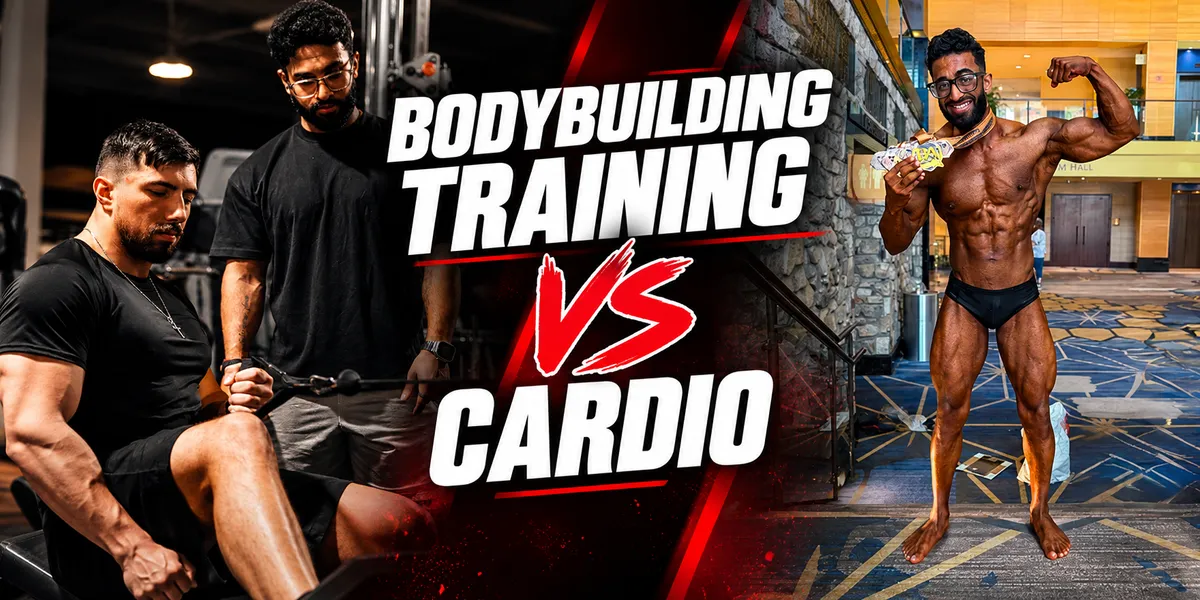
Bodybuilding Training vs Cardio: What Actually Builds Muscle
I get this one all the time: "I run four days a week and I still looking the same . What am I doing wrong?" Nothing, really. You're just using the wrong tool for the job. Running, cycling, and the stair climber are great for your heart, your stamina, and your calorie burn, but they don't give your muscles a reason to grow. Bodybuilding training does. If your goal is to add real size and shape, lifting has to be the main event, and cardio plays a supporting role. Here's why, and how I set up both.
What Bodybuilding Training Does That Cardio Can't
Muscle grows when it's asked to do something harder than it's used to. That's the whole game. When you lift a heavy load close to failure, your muscle fibers experience high mechanical tension, and your body responds by repairing them a little bigger and a little stronger. Then you add a rep or a bit of weight next week, and the cycle repeats. That's progressive overload, and it's that's how every lifter you look up to got there
Cardio doesn't work that way. A 30-minute jog asks your muscles to do the same moderate work over and over, which builds endurance but gives them no real reason to get bigger. You can't easily "add weight" to a treadmill the way you can to a barbell, and even when you push the pace, you're training your heart and lungs more than the muscle fibers that drive size.
Bodybuilding training also lets you aim. Want bigger shoulders? We pick the lateral raise, set the volume, and track it. Want to bring up your hamstrings? Same thing. I usually work in the range of 10 to 20 hard sets per muscle per week, spread across sessions, and I break down the exact structure in my post on how I set up bodybuilding training splits. Cardio can't be pointed at one muscle like that. Cardio can't target one muscle. Lifting can.
There's another reason lifting wins, and it's the one most people miss: you can measure it. Every set gives you a number, a weight times a rep count, and that number tells you whether you're progressing. Four shaky reps at a given load turning into eight clean ones is proof your muscle is adapting. A jog gives you a time and a heart rate, which are useful, but they don't tell you whether your shoulders, back, or quads got any bigger.
What Cardio Actually Does for You
I'm not anti-cardio, and I don't want you walking away thinking it's useless. Cardio improves how fast you recover between hard sets, how well your heart handles a long workout, and how comfortable you feel climbing stairs with groceries. It also burns calories, which helps when you're trying to lose fat.
There's a small catch worth being honest about. If you're brand new to exercise, or coming back after a long break, cardio can add a little muscle at first, because your body hasn't been challenged in a while. That effect fades fast, though, and it has a low ceiling. Within a few months, your legs adapt to the bike, and the muscle gain stops. Lifting keeps working because you can keep making it harder.
Two people can follow the same diet, and the one who lifts will carry more muscle at the end of it, even if the scale reads the same. That's body recomposition, and it's why lifters often look leaner at the same weight. A runner who loses 10 pounds without lifting usually loses some muscle along with the fat, and the body that's left can look softer than they expected. Bavandeep is a good example of the lifting side: only 15 pounds down on the scale over four months, but a completely different physique.
So the right question isn't "cardio or lifting?" It's "which one drives muscle growth, and which one supports it?" Lifting drives it. Cardio supports your recovery, your conditioning, and your waistline. When you treat them that way, they work together instead of fighting for your energy.
Where Cardio Helps and Where It Gets in the Way
They hear that cardio doesn't build muscle, so they either skip it entirely or pile on way too much. Neither one is great.
Too much hard cardio, especially long runs done right before or after leg day, can eat into your recovery. You only have so much energy to repair tissue, and if you spend it all on mileage, your legs don't have much left to rebuild. That's the interference effect, and it hits hardest when the volume is high and the sessions are crammed together. I've seen this firsthand: one client I coached for a year cut back his cardio, ate more, and finished down 20+ pounds.
Too little cardio isn't ideal either. A bit of walking and some easy conditioning help you recover, keep your resting heart rate healthy, and make it easier to hit a calorie deficit without losing your appetite for training.
When someone is cutting, I keep the barbell as the priority and use cardio as the support act. Nick Martinez came down 45 pounds in prep for his first show. You can see more real results on my transformations page.
Food matters here too. Without enough protein and total calories, neither cardio nor lifting will give you much to show for it. I cover how that fits with training in my nutrition coaching breakdown.
How I Set Up Lifting and Cardio Together
Here's the actual structure I use with clients at Antman Fitness. It isn't fancy, and that's the point.
First, lifting is the priority. Three to five sessions a week, built around the big compound movements and then isolation work for whatever you're bringing up. Every week, the goal is to do a little more than last time, whether that's another rep, a bit more weight, or better control. If your lifting isn't progressing, nothing else matters.
Second, cardio gets slotted around it. I like walking every day, plus one or two easy cardio sessions on non-lifting days or after training. I'd rather you do easy work you can repeat than one brutal session that wrecks your next leg day.
Third, we adjust. If your recovery drops, your sleep tanks, or your lifts stall, I trim cardio before I touch your training. If you're cutting and the deficit needs help, I add a little. Nothing gets changed all at once, and nothing gets changed without a reason.
That's how I coach it, whether you train with me online or in person near Old Bridge, NJ. If you're competing, my bodybuilding training program builds all of this around your show date. And if you just want to build muscle and look better, the same rules apply, just without a countdown clock.
If you're tired of spinning your wheels on the treadmill and ready for a plan that actually adds muscle, apply to train with me and I'll show you what your week would look like.
FAQs
1. Can cardio build muscle at all?
For complete beginners, a little. If you haven't trained in a while, cycling or incline walking can add some muscle in the legs early on. The effect is small and fades quickly, so it can't replace lifting if you want continued growth.
2. Will cardio make me lose muscle?
Not if you do it sensibly. Moderate cardio alongside regular lifting and enough protein won't cost you muscle. Problems show up when cardio volume gets very high, you're under-eating, or your recovery is already stretched thin.
3. How much cardio should I do if I want to build muscle?
I usually start with daily walking plus one or two easy sessions a week, then adjust based on your recovery and goals. If your lifts are climbing and you feel good, you're in the right range. If your legs feel flat all the time, it's probably too much.
4. Should I do cardio before or after lifting?
After, or on a separate day, in most cases. Doing hard cardio first can drain the energy you need for heavy sets. If you need to do both on the same day, lift first and keep the cardio easy.
5. Is HIIT better than steady cardio for keeping muscle?
Neither is magic. HIIT is time-efficient but taxing, so it can interfere with recovery if you do too much. Steady, easy cardio is gentler and easier to fit around a lifting plan, which is why I use it more often.
6. Can I lose fat without doing cardio?
Yes. Fat loss comes down to a calorie deficit, and you can create that through food alone. Cardio just gives you another lever to pull, and it's useful when your calories are already low and you don't want to cut them further.
